What is IEC 60320?
IEC 60320 defines appliance couplers used to connect equipment to a power supply. The designation refers to connector geometry and category; it is not a complete statement of the cable assembly's voltage, current, temperature, conductor size, approvals or country suitability. Read the markings on the outlet, cord and equipment.
C13, C14, C19 and C20 at a glance
| Designation | Form | Mates with | Typical context |
|---|---|---|---|
| IEC C13 | Female connector/receptacle | C14 inlet or plug | PCs, monitors and lower-power IT equipment |
| IEC C14 | Male inlet/plug | C13 receptacle | Equipment inlet or PDU cord input |
| IEC C19 | Female connector/receptacle | C20 inlet or plug | Higher-current IT and rack distribution contexts |
| IEC C20 | Male inlet/plug | C19 receptacle | Higher-current equipment inlet or cord input |
C13 and C14
A common computer power cord has a C13 connector on the equipment side and a country-specific mains plug or another IEC plug on the source side. In a rack, a PDU may expose C13 outlets; a cord entering that outlet therefore needs a C14 plug. Do not describe the PDU outlet as C14 simply because the cord is called “C14-to-C13”.
C19 and C20
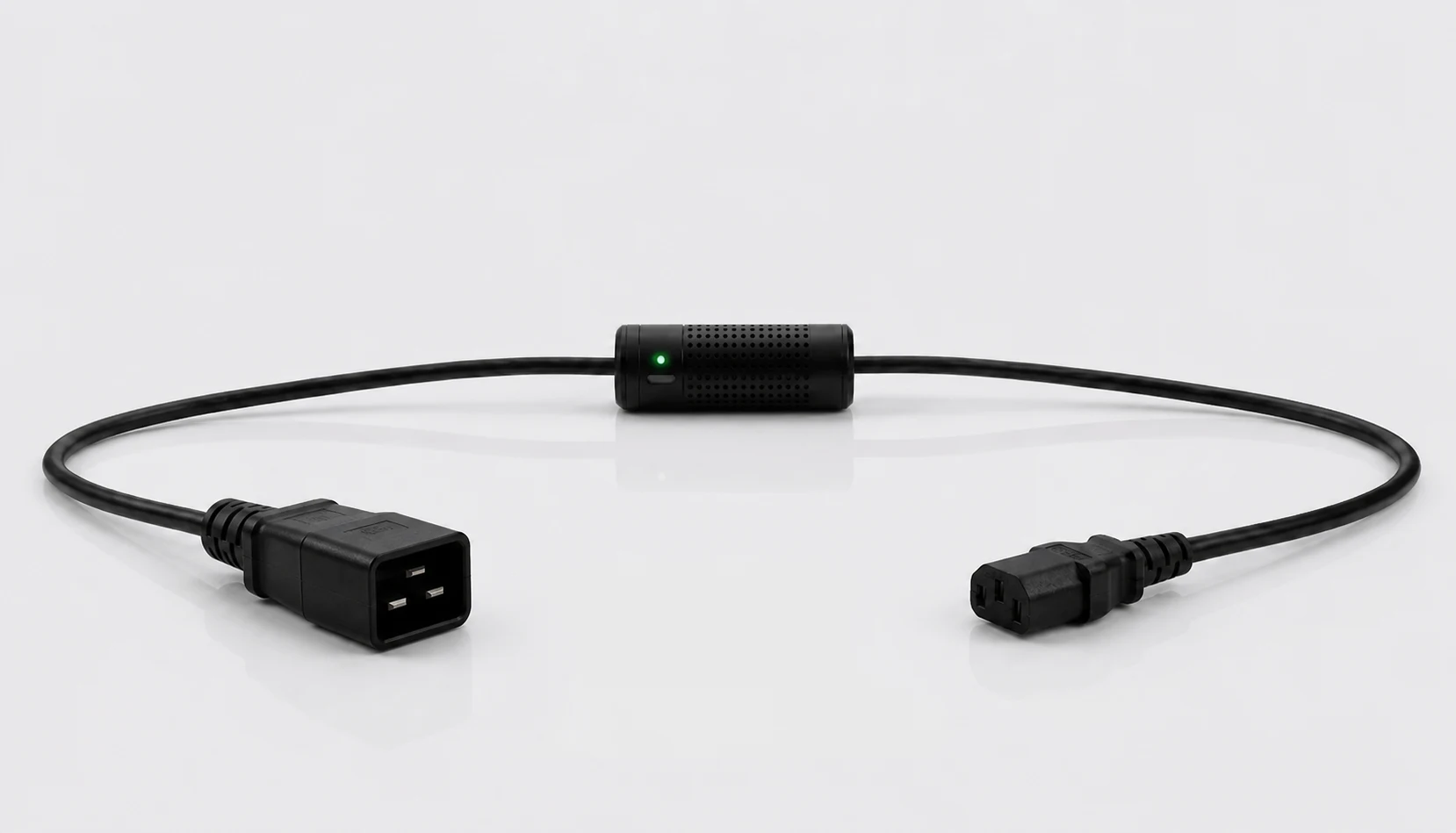
C19/C20 is a physically larger family used where equipment and distribution designs require a higher rated connector category. A PDU C19 outlet accepts a C20 plug. The downstream device may still have a C14 inlet, which is why a C20-to-C13 cord can be a valid directional description for a particular assembly.
How to select the right power cable
1. Read the source outlet
Inspect the PDU, UPS or wall source label and datasheet. Distinguish a C13 outlet from a C19 outlet and record the source voltage, frequency and outlet limit.
2. Read the equipment inlet
Inspect the exact device, not a similar model. A C14 equipment inlet requires a C13 cord connector. Some high-power devices use C20 inlets and need a C19 cord connector.
3. Check every rating in the chain
The permitted load is limited by the lowest-rated component: source outlet, protection, cable assembly, inline device and equipment. Consider conductor size, temperature class, steady current and startup or inrush current.
4. Check installation conditions
Allow strain relief, bend radius, latch clearance, airflow and service access. Do not use adapters to bypass an incompatible rating or protection scheme.
How many amps can these connectors carry?
Connector families have standardised rating envelopes, but a finished cable assembly may be rated lower because of conductor size, temperature, certification, local regulation or an inline component. Use the markings and approved datasheet for the exact assembly. All Smart Kablo variants in this guide are limited to 5 A continuous current, even if the connector family or upstream outlet has a higher rating.
Common selection mistakes
- Treating C13 and C19 as interchangeable sizes.
- Confusing the cord's plug name with the PDU outlet name.
- Assuming the PDU's aggregate rating is available at every outlet.
- Using average watts while ignoring startup current and power factor.
- Choosing by a product photo without reading labels.
- Assuming a connector used in one country is approved everywhere.
Mapping the Smart Kablo input
| Source | Input configuration to review | Load-side condition |
|---|---|---|
| PDU/UPS C13 outlet | C14 input | Compatible C14 equipment inlet via C13 connector |
| PDU/UPS C19 outlet | C20 input | Compatible C14 equipment inlet via C13 connector |
| Schuko outlet | Schuko input | Compatible C14 equipment inlet via C13 connector |
This is a starting map, not an approval. Verify the exact installation, voltage, current, protection and equipment behaviour with technical sales.
Does a C20 plug enter a C19 outlet?
Yes. C19 is the female receptacle and C20 is its mating male plug.
Can I connect C13 to C19?
Not directly; they are different families. Use only a correctly engineered and rated assembly for the actual source and load.
Does a larger connector make Smart Kablo higher current?
No. The product's continuous-current limit remains 5 A.