What is a UPS?
An uninterruptible power supply stores energy and supplies connected loads for a limited period when utility power fails. Topology, transfer behaviour, runtime, waveform, bypass, communications and battery condition vary by model. A UPS does not create unlimited runtime; it provides a controlled interval for continuity, generator start or graceful shutdown.
What is a PDU?
A rack power distribution unit takes an upstream supply and distributes it across multiple outlets. A basic PDU may be entirely passive. Metered, monitored and switched variants add different levels of current measurement, network visibility or outlet control. Read the exact datasheet rather than assuming every product called a “smart PDU” has the same functions.
| Question | UPS | PDU |
|---|---|---|
| Main job | Maintain or condition power for a limited period | Distribute upstream power to rack equipment |
| Contains stored energy | Normally yes | Normally no |
| Multiple equipment outlets | Model dependent | Core function |
| Per-outlet measurement | Not assumed | Only on suitable monitored models |
| Per-outlet switching | Not assumed | Only on suitable switched models |
The normal rack power chain
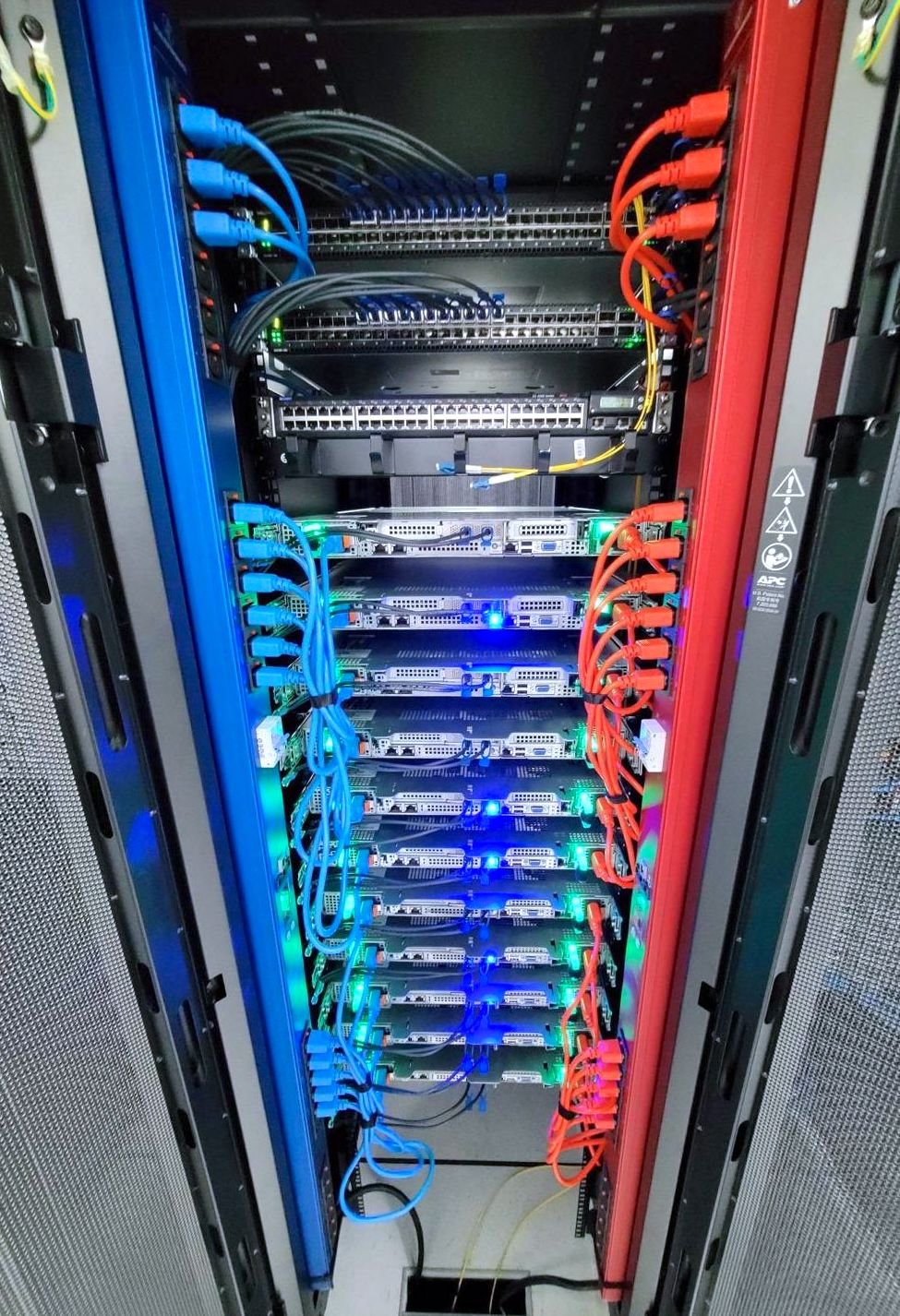
The exact design must follow the UPS and PDU manufacturers' rules, electrical regulations and the facility's protection design. Check input and output connectors, phase, voltage, frequency, current, breaker coordination, earth continuity and total load. Never exceed either an individual outlet rating or the upstream aggregate rating.
Can a PDU be connected to a UPS?
Often yes, when the equipment is designed and approved for that arrangement. The PDU does not extend UPS runtime; it shares the UPS's finite capacity among more outlets. Adding outlets must never be treated as adding available power. Include peak load, redundancy, startup current and future headroom in the calculation.
Which one do you need?
- equipment must ride through short outages
- you need time for a controlled shutdown
- the specified topology addresses power-quality requirements
- you need orderly rack distribution
- connector density and cable management matter
- a suitable model provides the required metering or switching
Where does an inline smart power cable fit?
Smart Kablo sits between a compatible source outlet and one compatible device. It can add a device-level measurement and authorised relay-control point without replacing the UPS or rack PDU. It is not a UPS, does not provide battery backup and does not increase PDU capacity.
Each load must remain within the 5 A continuous-current limit. Connector fit, voltage, current, inrush and equipment behaviour after power restoration must be verified. For a dual-PSU server, measuring or switching one feed does not represent the entire server.
Pre-purchase checklist
- List source and equipment connector types.
- Record voltage, frequency, steady current and startup characteristics.
- Calculate UPS runtime at the real load.
- Check PDU outlet and aggregate limits.
- Define whether you need rack totals, branch totals or device-level data.
- Document who is authorised to switch a load remotely.
Does a PDU keep equipment running in an outage?
Not by itself. It distributes whatever upstream power is available.
Does a UPS replace a PDU?
Not necessarily. Rack distribution and cable organisation may still require a correctly rated PDU.
Can Smart Kablo replace either device?
No. It is a compatible inline device-level measurement and control point, not backup power or rack-wide distribution.